
Finally, payroll that understands home care
Your caregivers want faster pay. You want a way to automate DOC payments. Legacy payroll gives you neither. Everee was built for exactly this problem.
'ADP said they knew home care.
They didn't.'
This is an exact quote we hear all the time. Legacy payroll promises they "get" home care. Then you spend 12 months customizing, programming, and fighting their system just to pay people correctly. Not with Everee.
What if payroll wasn't your biggest headache?
Everee isn’t just another payroll system trying to fit your square peg into their round hole. We built Flex Pay and Flex Suite specifically for the complexities of home care, from automated DOC payments to Medicaid timing to caregiver retention.
Caregivers get paid fast. You stay compliant. And you finally get your weekends back.
- Weekly or same-day caregiver pay without manual work or compliance risks
- DOC payments automated: federal tax-exempt, FICA compliant, state variations covered
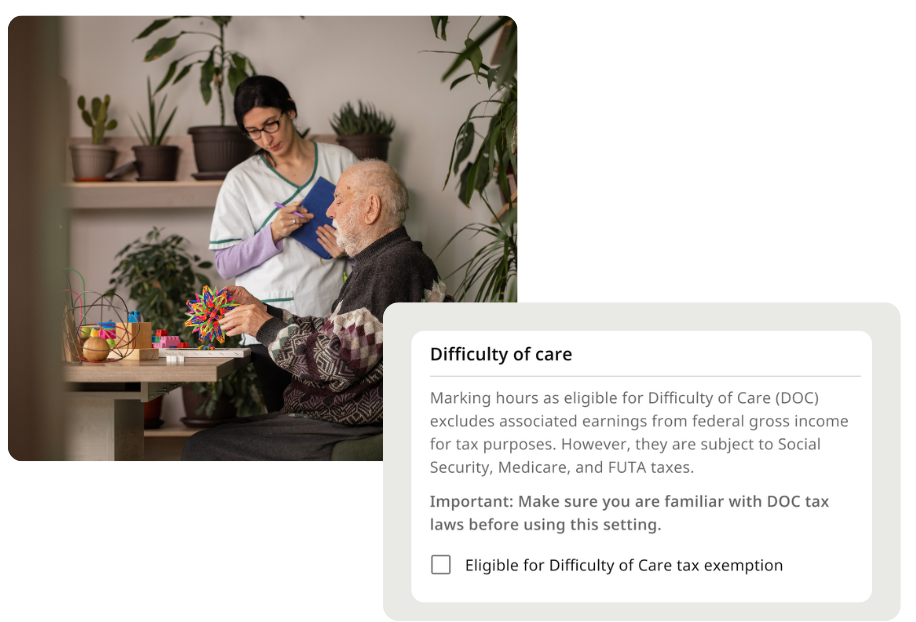
- Shift-level DOC control without spreadsheets or manual corrections
- Accurate W-2 reporting with Box 1 exclusions and Code "II" automatically
- Medicaid reimbursement timing solved: pay caregivers today with Flex Credit, pay us when funding arrives
- Multi-state compliance built-in for agencies operating across state lines
- Automated tax filings and audit-ready records so you can sleep easy
- Embeddable experiences so caregivers never have to leave your app
FLEX PLATFORM
Complete payroll that scales with you
Need multi-state compliance?
Building your own platform?
Discover embeddable and white-label payroll with Flex Build →
Want the full picture of payout and financing capabilities?
Frequently Asked Questions
What is home care payroll software?
Home care payroll software handles the specific mechanics of paying caregivers: difficulty of care (DOC) payment exclusions, Medicaid-funded reimbursement timing that often lags behind when caregivers need to be paid, multi-state compliance for agencies operating across state lines, and a workforce that’s frequently a mix of W-2 employees and 1099 contractors. Everee supports all of this in one platform, including the ability to pay caregivers before Medicaid reimbursement actually arrives.
How do home care agencies pay caregivers?
Caregivers are typically onboarded via mobile or web, log hours through a timeclock or timesheet, and are paid once that time is verified. Most home care agencies pay weekly. Everee supports marking caregiver earnings as Difficulty of Care by default or on individual time entries, and can pay on a standard cycle or same-day, depending on the agency’s pay schedule.
What are Difficulty of Care (DOC) payments and how are they handled in payroll?
Difficulty of Care payments are payments made to an individual care provider under a state Medicaid Home and Community-Based Services Waiver program, classified as excludable under Section 131 of the Internal Revenue Code per IRS Notice 2014-7. In payroll, earnings marked as DOC are still subject to Social Security, Medicare, and FUTA, but are excluded from federal income tax withholding and, outside Pennsylvania, excluded from W-2 box 16 taxable wages. Everee lets agencies mark workers as DOC by default or flag individual time entries, available through timesheets, time upload, and API.
How does Medicaid reimbursement timing affect caregiver payroll?
Home care agencies are often paid by Medicaid on a delayed reimbursement cycle, but caregivers still expect to be paid on a normal schedule, sometimes daily or often weekly. That timing gap is one of the most common cash flow pressures in the industry, and it’s a major driver of caregiver attrition when agencies can’t pay on time. Everee’s Flex Credit is built to address exactly this gap: fronting payroll so caregivers get paid on schedule while the agency repays once Medicaid funds arrive.
How do home care agencies pay caregivers before Medicaid funding arrives?
Agencies can use Everee’s Flex Credit to front caregiver payroll ahead of Medicaid reimbursement, repaying Everee on a schedule tied to when those funds actually come in rather than delaying caregiver pay or relying on a separate loan or factoring arrangement to bridge the gap.
Are DOC payments subject to federal income tax?
No. Difficulty of Care payments are excluded from federal income tax under IRS Notice 2014-7. They are still subject to Social Security and Medicare (FICA) and FUTA, and — in Pennsylvania specifically — are included as taxable wages in box 16 of the W-2. They’re also excluded from 1099-NEC/1099-K reporting.
How do home care agencies manage payroll compliance across multiple states?
Multi-state home care compliance covers correct tax withholding and filing by jurisdiction, state-specific handling of DOC payment exclusions (Pennsylvania treats DOC wages differently for state tax purposes than other states), and worker classification rules that can vary by state. Everee applies the correct jurisdiction’s rules automatically based on where care is provided, rather than requiring manual configuration for each new state an agency operates in.
What's the difference between W-2 and 1099 classification for home care workers?
W-2 caregivers are employees of the agency, with the agency withholding and remitting payroll taxes and issuing a W-2 at year-end. This is the most common classification for home care agencies. 1099 caregivers are independent contractors who are responsible for their own self-employment taxes and receive a 1099-NEC if they’re paid individually (or a 1099-K in some cases). DOC payment exclusions specifically apply to W-2 wage reporting, not 1099 reporting.